

By William · Updated 13 November 2026
Store LEGO for what you do with it, not for how much you have. If it is for tidy-up play, use one shallow box. If you rebuild sets, keep each set in its own labelled bag. If you build your own models, sort by part type into a few broad groups in shallow drawers. If you build by colour, sort by colour. If it is for display, use a closed case out of the sun. Then keep everything dry and below 40°C.
The colour-or-type argument is older than most LEGO fans. In 2001 Remy Evard posted a joke 27-step history on the Lugnet storage forum, tracing how a collector drifts from sets to colour to part to overflow buckets. Most of those arguments, I think, are people describing different jobs. A parent clearing a bedroom floor, a collector who rebuilds sets and someone designing their own spaceship need different systems, and LEGO’s own help page on sorting and storing bricks makes the same point: the best storage depends on how you sort as well as how big the collection is. So this guide starts with the job, not the container. There is a free printable label sheet at the end.
Key takeaways
- Pick the job first: tidy-up play, rebuilding sets, your own models, colour builds or display. If two describe you, run two routes side by side.
- Own models: sort by part type. It is the most common advice among experienced builders, and mine too.
- Colour sorting is not wrong. It is right for mosaics, big single-colour builds and young children tidying up.
- Size is a second check: split any container you can no longer search at a glance.
- LEGO’s own rules: dry, out of direct sunlight, nothing above 40°C, no dishwasher.
How should you store LEGO? Start with what you do with it
Find the row that describes most of your building, and set that system up first. The last column is the sign that you have outgrown it.
| What you mostly do | Sort by | Keep it in | Label with | Sign it is not working |
|---|---|---|---|---|
| Tidy-up play young builders | Hardly at all; figures in their own pot | One shallow box or a play-mat bag a child can manage | A picture and a word | Tidying takes longer than playing, or bricks live on the floor |
| Rebuild sets | Set | One bag or box per set, manuals in a binder | Set number and name | You start raiding bags for parts to build your own things |
| Own models | Part type, in broad groups | Shallow drawers of one kind, so you can add more | Part group, on the front | You open three drawers for one part, or a drawer is too full to see into |
| Colour builds mosaics, sculpture, walls | Colour for basic bricks and plates, type for the rest | Colour tubs plus a few type drawers | Colour swatch | Small parts vanish into a tub of one colour |
| Display | Shelf or theme | Closed case or shelf, out of the sun | Not needed | Dust, or a sunny wall |
Route 1
Tidy-up play: one container a child can manage
For young builders the best system is the one they can put away without help, which usually means very little sorting. A big, shallow bin that slides under the bed works well, with one small box for minifigures and special pieces; drawer units can wait until the builder is older. One parent’s version of this was a round paddling pool that slid under the bed. LEGO also sells a tote that opens out as a playmat: you scoop everything back in and pull the drawstrings.
Before buying anything, ask the child how they want it sorted. Some want sets kept together, some want colours, and a system they chose is one they are more likely to keep up. An empty basket in each room catches the bricks that escape, and a table or corner where a build can stay up saves arguments about breaking up half-finished models at tidy-up time.
My advice: go shallow here too. I would rather a child could see what is in a box than dig for it. If you do add drawers, use labels with a picture as well as a word, which is why every label on page 1 of the sheet has an icon. Colour sorting is fine at this stage if it gets the floor clear.
Route 2
Rebuilding sets: keep each set together
If you mainly rebuild official sets, sort by set: one zip-top bag or small box per set, labelled with the set number and name. Plenty of storage guides skip this route, yet it suits collectors and anyone who mostly builds from instructions. For a child, a picture of the box stuck on the front of the bin makes it obvious what goes where.
The drawback is that a bag of parts tied to one model can stop you building anything new with them. That matters for a builder who wants to create, and not at all for someone who loves the sets as they are. My middle ground is to keep your favourite sets whole and let the rest go into the type drawers.
Where do the instructions go?
Flat, dry and in set-number order. An A4 ring binder with punched pockets suits most collections, and LEGO itself suggests binders, plastic wallets or its app. The LEGO Builder app holds instructions for old and new sets, searchable by set number, theme or year, which makes parting out a set less of a gamble. I would still keep the booklets for sets I care about.
Should I keep the boxes?
That is a space question more than a storage one. Boxes take a lot of room, so decide which matter to you, flatten or nest the rest, and keep the ones you keep dry and out of the sun.
Route 3
Building your own models: sort by part type
For building your own models, sort by part type, starting with a few broad groups and splitting a group only when its container gets crowded. The reason is easy to test: try finding one red 1 × 2 plate in a tub of red parts, then in a drawer of plates in mixed colours. Colours are easy to tell apart at a glance; shapes in a pile of one colour are not. Re-sorting a big collection later is a long job, so it pays to choose type early.
How many groups? Some builders start with four (bricks, plates, Technic and everything else); others prefer anything from six to twelve. I would start with the twelve on the label sheet and leave any you do not need empty. When a drawer overflows, split it, and not before: fine splits made too early only mean more drawers to open.
Which containers?
Shallow, see-through and all the same kind. Short, flat drawers are quicker to search because small parts do not sink to the bottom, and if every container is the same type, the drawers can be rearranged when you split a group. In the UK, IKEA’s TROFAST frames take boxes in several depths; the 42 × 30 × 10 cm box is the shallow one, against 23 cm and 36 cm for the deep ones. A small-parts cabinet on the desk is handy for the tiniest parts, but I would not make those cabinets your main storage: each drawer holds very little, and sorting into dozens of them takes a long time.
Three habits that keep a type system working
- A “still to sort” box. New parts go in there and get rehomed in a few minutes at the start of each building session, not the moment they arrive.
- A project box. Tip a half-finished build and its parts into one large tub, so the table is free and the build can be picked up later.
- Labels on both short ends. Then it does not matter which way round a box goes back on the shelf.
Which parts go in which group?
Rebrickable, the fan-run parts database, has about 70 part categories. That is too many for a home system, so here is how our twelve label groups fold the main ones together.
| Label group | Rebrickable categories it covers |
|---|---|
| Bricks | Bricks; Bricks Special; Bricks Wedged |
| Plates | Plates; Plates Special; Plates Wedged |
| Tiles | Tiles; Tiles Special |
| Slopes and curves | Bricks Sloped; Bricks Curved; Tiles Round and Curved |
| Beams, pins and axles | Technic Beams, Pins, Axles, Connectors, Gears, Bushes |
| Round parts | Bricks Round and Cones; Plates Round Curved and Dishes |
| Wheels and vehicle parts | Wheels and Tyres; Transportation – Land; Transportation – Sea and Air |
| Windows, doors and fences | Windows and Doors; Bars, Ladders and Fences; Panels |
| Figures and accessories | the Minifig categories; Animals / Creatures; Plants & Trees |
| Printed and special parts | printed parts from any category; Stickers; Flags, Banners and Signs |
| Transparent parts | any transparent-coloured part, whatever its shape |
| Still to sort | new arrivals, then rehome them each session |
Most arguments about colour or type are people describing different jobs.
Route 4
Building by colour: when colour sorting is right
Sort by colour if most of what you build is about colour: mosaics, sculpture, or large walls of one colour. If you are building a big black wall, digging through every type drawer for black bricks is slow, and colour bins win. Colour sorting also suits builders who mostly use standard bricks.
The catch is small parts, which disappear into a tub of one colour. The practical answer is a hybrid, and it is how I would set it up: colour tubs for the basic bricks and plates you use in bulk, type drawers for everything else.
Route 5
Displaying built sets: sunlight, heat and dust
LEGO’s guidance is to keep bricks dry, away from any heat source and out of direct sunlight, and never above 40°C, because heat may make them brittle or discoloured over time. That rules out a sunny windowsill or a shelf above a radiator, and it is the reason to check a loft or garage before using it.
Dust is the other problem. A display case keeps most of it off; for sets on open shelves, a soft brush does the job. If a built set has to be packed away, use a clear tote box and photograph the set first, so you can put back anything that falls off. For sets that get dusty anyway, LEGO’s advice on cleaning bricks is to wash them by hand in water no hotter than 40°C, with a little mild detergent if needed, rinse and air-dry. LEGO says not to use a dishwasher or washing machine, and not to dry bricks in direct sunlight or with a hair dryer, oven or microwave. Electronic parts should only be wiped with a damp cloth and a mild detergent without perfume or oil.
How big is your collection? Size as a second check
Collection size decides when to step up, not which system you need. Rules of thumb put the point where sorting starts to pay somewhere between about ten sets’ worth and about 3,000 pieces, and the exact number matters less than the direction: the bigger the collection, the finer the sort.
Rather than counting pieces, I would watch for three signs:
- You cannot see the bottom. If you have to tip a container out to find something, split it or move it to a shallower one.
- One group is twice the size of the others. That group is ready to split, for example plates into small plates and large plates.
- Things go back in the wrong place. Put each part where someone else would look for it first, not where it happens to fit.
Five storage dilemmas, and what I’d do
The same five questions come up whenever builders talk about storage. Here is my answer to each.
| Dilemma | My answer | Why |
|---|---|---|
| Colour or type? | Type for your own models; colour for colour-led building and young children | A shape is hard to spot in a pile of one colour; a colour is easy to spot in a pile of one shape |
| Sort at all? | One box is fine for play; sort once you are hunting for parts | A single box costs nothing and throws up chance finds, but it gets slower to search as it grows |
| Keep sets whole? | Keep favourites whole; the rest goes into type drawers | Bagged sets are easy to rebuild, but they tie parts to one model |
| Small drawers or big? | Big and shallow first; a small-parts cabinet only for tiny parts | Small cabinets hold little and make sorting slow |
| Size or use first? | Use first, size as the trigger to split | Two collections of the same size can need opposite systems |
What I’d buy for each route
These are product types that suit each route, not the only good options. Availability and links were checked on 11 November 2026 and can change; I will re-check them each year. As an Amazon Associate, Brick Imagination earns from qualifying purchases.
Tidy-up play · one big box
The storage box we reviewed
If you want one large, bright box for a young builder, see our LEGO storage box review.
Rebuild sets · clear lidded boxes
Really Useful Box 9 litre, clear (pack of 3)
Clear, stackable and clip-lidded, with room for several bagged sets each. Also a good “still to sort” or project box.
Rebuild sets · instructions
A4 punched pockets, 90 micron (pack of 100)
Heavy-duty clear pockets for a ring binder, one booklet per pocket, filed by set number.
Own models · shallow drawers
IKEA TROFAST storage combination with nine shallow boxes
A frame of 42 × 30 × 10 cm shallow boxes, enough for the twelve label groups once you add a second unit or a few lidded boxes. Not an affiliate link.
Own models · tiny parts on the desk
Raaco 44-compartment cabinet organiser
A cabinet of 44 clear pull-out drawers for the smallest parts you use most. Keep it for those; bulky groups belong in the shallow drawers.
Any route · figures and accessories
Stanley Sortmaster Junior organiser, 14 compartments
A see-through case with compartments for minifigures and their accessories, or for one set’s small parts.
Free printable LEGO sorting labels
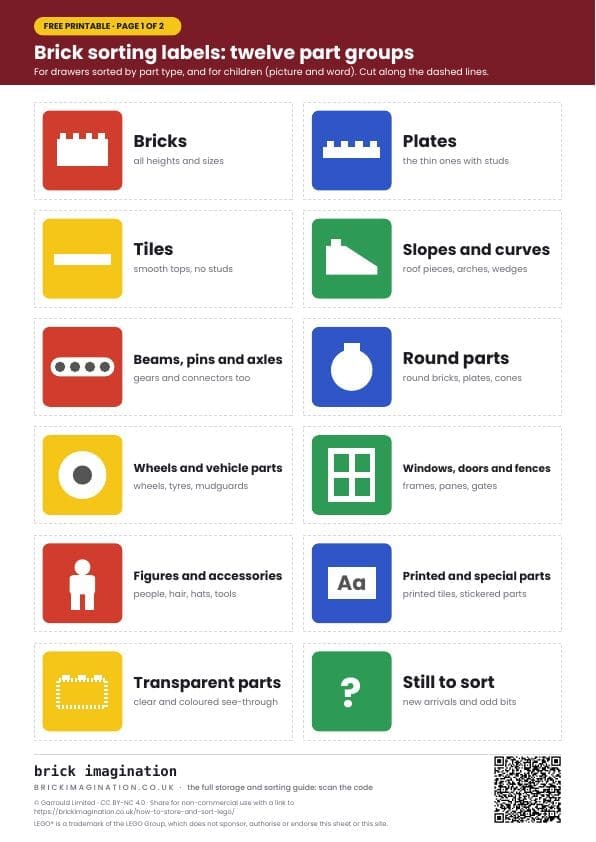
Brick sorting labels (PDF, A4, 2 pages). Page 1: twelve part groups with icons, for drawers on the own-models route and for children. Page 2: six set-bag tags for the rebuild-sets route, and sixteen finer groups for when a drawer needs splitting. Free, printable, no sign-up.
© Garrould Limited · licensed under Creative Commons Attribution-NonCommercial 4.0 (CC BY-NC 4.0). Share freely for non-commercial use with a link to this page. If you want a label for every individual part, printable part labels for label printers are listed in Sources and further reading.
LEGO storage and sorting: questions people ask
What is the best way to store LEGO?
Match the storage to what you do with it. For young children tidying up, one shallow box or a play-mat bag. For rebuilding sets, one labelled bag per set with its instructions filed. For building your own models, sort by part type into a handful of broad groups in shallow drawers. For display, a closed case or a shelf out of the sun. Whatever the system, LEGO's own advice is to keep bricks dry, away from heat and direct sunlight, and below 40°C.
Should you sort LEGO by colour or by type?
By type if you build your own models, because the part you need is easier to spot among same-shaped pieces in mixed colours than among hundreds of pieces of one colour. Colour makes sense for mosaics, sculptures and big single-colour walls, and for young children who only need to tidy up. LEGO itself says there is no right or wrong way.
How do you store LEGO sets you want to rebuild?
Keep each set in its own zip-top bag or box labelled with the set number and name, and file the instruction booklets in an A4 binder or a box by set number. The LEGO Builder app also holds instructions for old and new sets, searchable by set number, theme or year.
How do you store built LEGO sets long term?
Somewhere dry, away from heat sources and out of direct sunlight, and below 40°C, which is the limit LEGO gives before bricks may become brittle or discoloured. A display case or a closed cupboard keeps dust off. If a set has to go into a box, photograph it first so you can repair it later.
Is it safe to store LEGO in a loft or garage?
Only if the space stays dry and never goes above 40°C. LEGO's guidance is to keep bricks dry, away from heat sources and out of direct sunlight, so check how hot the loft gets in summer and whether the garage gets damp before using either.
What is the cheapest way to store LEGO?
Sandwich bags and food storage containers, both on LEGO's own list of what fans use. Bags suit one set each; food tubs suit a few broad part groups. Spend money on drawers only once you know which groups you need.
When should I start sorting my LEGO?
When finding a part in the one container you have takes longer than it should. For someone building their own models that tends to be when the collection no longer fits in one box, which a common rule of thumb puts at about 3,000 pieces. If the LEGO is mainly for tidy-up play or rebuilding sets, you may never need to sort by part at all.
Can you wash LEGO in the dishwasher?
No. LEGO says not to put its pieces in a dishwasher or washing machine. Wash them by hand in water no hotter than 40°C, rinse well and let them air-dry away from direct sunlight, without a hair dryer, oven or microwave.
Sources and further reading
This guide was worked out from LEGO’s own care advice and a wide reading of fan guides, parts data and builders’ forum discussions; these are the pages worth visiting. Links open in a new tab.
- LEGO Group: Sorting and storing your LEGO bricks
- LEGO Group: Cleaning your LEGO bricks
- LEGO Group: Building instructions and the LEGO Builder app
- LEGO Group: Best LEGO storage ideas
- IKEA GB: TROFAST storage combination with nine shallow boxes (s29574451)
- IKEA GB: Storage ideas for LEGO
- Rebrickable: parts catalogue and part categories
- Brick Architect: LEGO organisation guide (the 3,000-piece guideline)
- Brick Architect: part labels for label printers
- LEGO Education Community blog: LEGO storage in the classroom (2020)
- Lugnet storage archive: the evolution of LEGO sorting (2001)
Written by William for Brick Imagination · Updated 13 November 2026. LEGO® is a trademark of the LEGO Group, which does not sponsor, authorise or endorse this site. TROFAST is an IKEA product name; other product names belong to their owners.


0 Comments