
By William · Updated 14 November 2026
Display LEGO sets where they fit, stay put and stay out of the sun. Measure the set, give it a home that suits its size, keep your favourites behind glass or acrylic so dust cannot settle, keep everything out of direct sunlight and away from radiators, and anchor any tall unit to the wall.
Most LEGO display ideas start with the furniture. I think it works better the other way round: start with the set. A minifigure, a 135 cm ocean liner and a 70 cm rocket need different homes, and the right shelf for one is a hazard for another. Below is a decision table by size, the dust and fading rules that keep a display looking new, and a free printable dust-and-light checklist with a six-monthly check log.
Key takeaways
- Size decides the home: case or ledge for minifigures, cube shelf or glass cabinet for standard sets, low and deep for long sets, low and anchored for tall ones.
- Check the load figure: a KALLAX shelf takes 13 kg, a BLÅLIDEN glass shelf 3 kg, a MOSSLANDA ledge 7.5 kg. Weigh big sets first.
- Dust: enclose what matters, brush open shelves monthly, wash only when a set comes down.
- Light: no direct sun and nothing above 40°C. A plain acrylic case stops dust, not all UV.
- Safety: anchor tall units to the wall and keep heavy sets low.
Where should each set go? A LEGO display decision table by size
Find the row that matches the set, then check the last column before you put it up. The dimensions and load limits are the makers’ own figures.
| What you are displaying | Best home | Dust plan | Watch out for |
|---|---|---|---|
| Minifigures | A stacking minifigure case (LEGO’s 16-figure case is about 37 × 18 × 4 cm) or a narrow picture ledge | Closed case; a ledge needs a monthly brush | Hanging cases need fixings that suit your wall |
| Small and flat builds mosaics, small Botanicals, small vehicles | A 12 cm-deep picture ledge, a deep frame, or the top of a unit | Soft brush monthly, or a small case for favourites | A MOSSLANDA ledge takes 7.5 kg in total; keep off sunny windowsills |
| Standard sets anything that fits a 30 cm-deep shelf | A cube shelf (KALLAX is 39 cm deep) or a glass-door cabinet | Doors on the unit, or an acrylic case for the ones you care about most | 13 kg per KALLAX shelf; 3 kg per BLÅLIDEN glass shelf |
| Long sets ships, trains, long vehicles | A low, deep surface such as the top of a sturdy unit, or a long, low case | A long case, or a monthly brush | Overhang: measure length and depth; LEGO’s Titanic is 135 cm long |
| Tall sets towers, rockets, tall buildings | Low down, on the floor or a low unit, out of walkways | Brush monthly; a tall case if you can fit one | Anchor the unit; LEGO’s Artemis rocket stands 70 cm tall |
| Flying builds spaceships, aircraft | An angled stand or a wall mount; LEGO suggests about 45 degrees to suggest flight | Brush monthly | Wall mounts need fixings rated for the weight |
Measure and weigh before you buy
Measure width, depth and height, and leave a little clearance if the set goes in a case or cabinet so it can come out without catching. Then weigh it on bathroom scales and compare the figure with the load printed on the furniture maker’s product page. IKEA gives 13 kg per shelf and 25 kg on top for a KALLAX unit, 3 kg per glass shelf for a BLÅLIDEN cabinet and 7.5 kg for a MOSSLANDA picture ledge. A big set that is fine on a cube shelf can be too heavy for a glass one.
Shelves, glass cabinets or acrylic cases: which suits your set?
Open shelves show the most and usually cost less, glass cabinets protect a group of sets from dust, and an acrylic case is the best protection for a single favourite. A growing collection can use all three.
| Option | Good for | Dust | Light | Remember |
|---|---|---|---|---|
| Open shelves and cube units | Standard sets, sets you rotate often | Settles; brush monthly | Only as good as the wall it is on | Tall units must be anchored |
| Glass-door cabinet | A group of medium sets; minifigures on risers | Kept off well | Glass on a sunny wall still lets light in | Check the glass-shelf load limit |
| Individual acrylic case | One precious or fragile set | Kept off; nothing to knock | Ordinary acrylic lets part of the UV-A band through | Only a stated UV-filtering grade protects from light |
| Picture ledge or frame | Minifigures, mosaics, flat builds | Settles; brush monthly | Keep off sunny walls | Small footprint, good for small rooms |
| Angled stand or wall mount | Spaceships and aircraft | Settles; brush monthly | As for shelves | Fixings must suit the wall and the weight |
Cube shelves
Cube units suit sets because the compartments frame each one. A KALLAX unit is 39 cm deep, takes 13 kg per shelf and carries IKEA’s warning that it is a tipping hazard and must be securely anchored. You can turn an open unit into a dust-proof one by adding a clear acrylic door; if you cut and drill your own, use thick sheet, because thin acrylic can crack when it is drilled.
Glass-door cabinets
A tall, narrow cabinet puts several sets in a small footprint. IKEA’s BLÅLIDEN is 35 cm wide, 32 cm deep and 151 cm tall, made of tempered glass, and rated at 3 kg per shelf, which suits minifigures, small Botanicals and light sets better than big ones. Like every tall unit, it must be anchored.
Acrylic display cases
A case is the simplest answer to dust and knocks for one set you care about. What a plain acrylic case does not do is protect against fading: ordinary clear acrylic lets very little UV through below about 345 nm, but between there and visible light (around 400 nm) how much gets through depends on the thickness of the sheet, so a clear box on a sunny shelf can still yellow its contents. UV-filtering acrylic exists, and one maker sells a grade it says blocks nearly all UV up to about 390 nm, but you only get that protection if the case is made from it. If a listing just says “UV-resistant”, treat the case as a dust cover and keep it out of the sun.
Ledges, frames and stands
For minifigures and flat builds, a picture ledge is an inexpensive wall display. A MOSSLANDA ledge is 115 cm long and 12 cm deep and takes 7.5 kg; the fixings are sold separately because they depend on your wall. For spaceships and aircraft, LEGO suggests tilting them at about 45 degrees on a stand so they look as if they are flying.
How to keep dust off LEGO
Stop dust settling first, then make removing it a small, regular job rather than a big one. I think of it as three lines of defence.
- Enclose. A glass-door cabinet, an acrylic door on a cube unit or a case keeps most of the dust off. Spend that protection on the sets that are hardest to clean: detailed builds, anything with lots of small parts, and anything you would rather not take apart to wash.
- Place. Dust near a kitchen, cigarette smoke or hairspray tends to be greasy and harder to brush off, so keep open shelves away from those. Some collectors also run an air purifier with a HEPA filter in the display room to reduce what settles.
- Routine. A thin layer of dust brushed off once a month comes away easily; years of it do not. A large, soft make-up brush or a soft detailing brush lifts dust from between studs, a hand air blower clears gaps, and a small hand vacuum works if you stretch a piece of stocking over the nozzle so loose parts are not sucked up. Skip new tumble-dryer sheets, which can leave a residue.
When dust has set in
Leave deep cleaning until a set comes down. Then follow LEGO’s own cleaning advice: wash pieces by hand in water no hotter than 40°C with a soft cloth or sponge, add a little mild detergent if needed, rinse in clear water and let them air-dry. LEGO says never to use a washing machine or dishwasher, and not to dry bricks in an oven, a microwave, with a hair dryer or in direct sunlight. Parts with electronics or metal should only be wiped with a damp cloth and a mild detergent without perfume or oil, and I would keep stickered parts out of the water too. Our guide to cleaning LEGO safely sorts which parts can be soaked and which only wiped, and how to dry them without spotting.
Sun decides where a set goes. A soft brush once a month does the rest.
How to stop LEGO fading and yellowing
LEGO’s advice is to keep bricks out of direct sunlight and away from any heat source, and never above 40°C, because they may become brittle or discoloured over time. White shows it most, turning yellowish; blue can go a dirty, brownish shade, and the side facing the window changes first.
Two things make light worth taking seriously. First, museum conservation guidance treats light damage as cumulative and irreversible: every hour adds to the total and nothing takes it away, which is why the RAF Museum’s light policy filters UV from windows and lamps, rotates exhibits and switches display lights off when nobody is looking. It classes plastics as moderately sensitive. Second, newer bricks are not immune. The Rambling Brick fixed tiles in the original white and the newer white to a post in a back garden for most of a year; both yellowed to a similar degree, which hints that the plastic, not the pigment, is the weak point. Indoors the change is far slower, and a few sunny weeks are unlikely to show, but months on a bright windowsill can.
Five light rules for a display
- No direct sun at any time of day. Check the spot in the morning and the afternoon; the sun moves.
- No heat. Not above a radiator, beside a heater or in a conservatory, and nowhere that can pass 40°C, so check how hot a loft gets in summer before using it.
- Shade the window if you cannot move the shelf. Blinds, lined curtains and UV-filtering window film all cut the light that reaches it.
- Use LEDs, and turn them off. LEGO suggests LEDs behind a set to pick out detail or below it for drama. Very bright lights close to a set count as strong light too, so keep them back a little and switch them off when the room is empty.
- Check every six months. Lift a few bricks off a model and compare the faces that were covered with the ones that were not. If the exposed faces look darker or yellower, move the set. Before blaming the shelf, compare with a newer set: some off-white parts are a different production tone, not damage.
Keeping tall shelves and heavy sets safe
Anchor any tall display unit to the wall, keep the heaviest sets on the lowest shelves, and never let a child climb the shelves to reach a set. RoSPA advises that furniture at risk of being pulled over should be secured to the wall, and notes that children have died or been seriously injured by heavy objects such as furniture and televisions.
IKEA’s Secure it advice is to use the restraint that comes with the furniture plus fixings that suit your wall: a wood screw straight into a timber stud, or a plug and screw for plasterboard without a stud and for solid masonry. If you are not sure what your wall is made of, IKEA’s advice is to get professional advice before drilling. Two more habits I would add: keep a big set off any shelf that hangs over a bed or a sofa, and do not stack loose sets on top of a unit beyond the maker’s top-load figure.
Rotate the collection
Give your display a fixed amount of space and rotate sets through it. It solves two problems at once: shelves stop overflowing, and no set sits in the same light for years. One adult fan in LEGO’s own big-set display article keeps large sets out for two months and then swaps them or puts them back in their boxes, and some families cap the display at a shelf or two so that a new set means an older one comes down.
My rule would be to rotate the biggest and most light-exposed sets first. When a set comes down, dust it, wash it if it needs it, then bag it with its instructions; our guide to storing and sorting LEGO covers bags, boxes and labels.
Children’s rooms and collectors’ shelves
In a child’s room, put the sets they play with low and within reach and the ones they only look at higher up or behind doors, and anchor everything tall. Low units at play height work well for big castles and vehicles that still get played with, and floating shelves suit finished models. A collector’s shelf is a different job: the sets are there to be looked at for years, so cases, the light rules and rotation matter more than reach.
What I’d buy for each size
These are product types that fit the rows of the table, not the only good options. Availability and links were checked on 14 November 2026 and can change; I will re-check them each year. None of the acrylic cases below states a UV-filtering grade, so treat them as dust covers. As an Amazon Associate, Brick Imagination earns from qualifying purchases.
Minifigures
LEGO Minifigure Display Case 16, black
Sixteen compartments behind a clear door, stackable, and slim enough for a wall or a desk.
Standard sets · one favourite
ROKR acrylic display case, 28.6 × 22.9 × 31.3 cm
A clear case for a single set that fits inside those measurements, with room to lift it out.
Long, low builds
sourcing map acrylic display case, 41 × 21 × 15.5 cm
A long, low clear case for vehicles and other long builds under about 15 cm tall.
Standard sets · open shelving
IKEA KALLAX shelving unit
Cube shelving 39 cm deep, 13 kg per shelf. Anchor it. Not an affiliate link.
Several light sets behind glass
IKEA BLÅLIDEN glass-door cabinet
35 × 32 × 151 cm, tempered glass, 3 kg per shelf. Anchor it. Not an affiliate link.
Minifigures and flat builds
IKEA MOSSLANDA picture ledge, 115 cm
12 cm deep, 7.5 kg. Fixings to suit your wall are sold separately. Not an affiliate link.
Any tall unit
Metal anti-tip furniture straps (pack of 6)
Steel cable straps for fixing bookcases and cabinets to the wall. Use wall fixings that suit your wall.
Dusting · gaps between studs
K&F Concept air blower
A hand-squeezed blower made for camera lenses; it clears dust from between studs without anything touching the model.
Dusting · open shelves
Soft detailing brush set (5 brushes)
Five soft brushes for the monthly going-over.
Free printable LEGO display checklist: dust and light
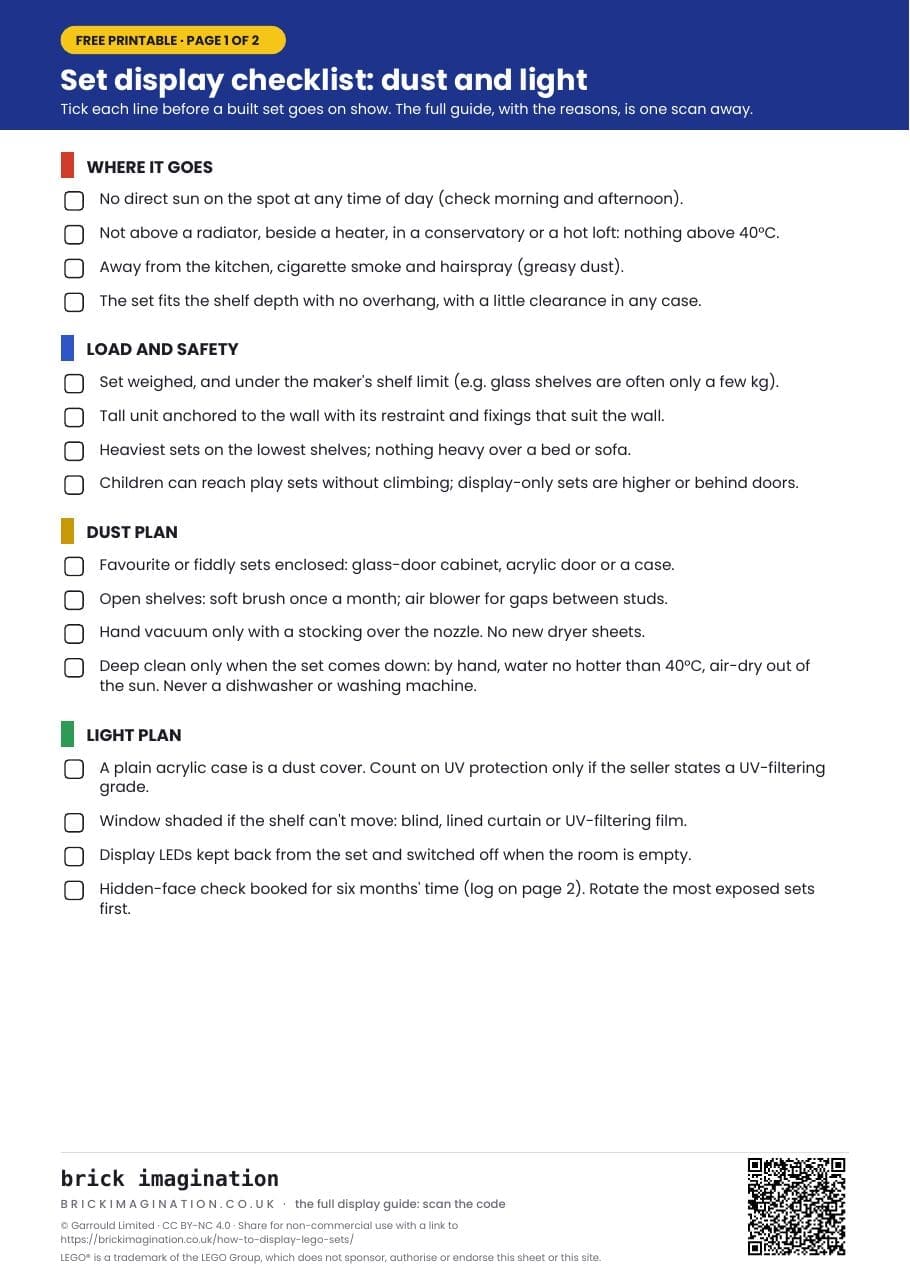
Set display checklist: dust and light (PDF, A4, 2 pages). Page 1: what to check before a set goes on show, covering sun, heat, load, anchoring, dust and lighting. Page 2: a six-monthly check log for your shelves, with how to do the hidden-face check. Free, printable, no sign-up.
© Garrould Limited · licensed under Creative Commons Attribution-NonCommercial 4.0 (CC BY-NC 4.0). Share freely for non-commercial use with a link to this page. If you share it, please link to this page.
LEGO display questions people ask
What is the best way to display LEGO sets?
Match the home to the size of the set. Minifigures go in a stacking case or on a narrow ledge, standard sets on a cube shelf or in a glass cabinet, long sets on a low, deep surface, and tall sets low down on an anchored unit. Whatever you choose, keep it out of direct sunlight and away from heat, and put the sets you care most about behind glass or acrylic to keep the dust off.
How do you keep dust off LEGO sets?
Enclose what matters most in a glass-door cabinet or an acrylic case, keep open shelves away from the kitchen and anywhere smoky, and give open shelves a light going-over with a soft brush about once a month. A hand air blower clears gaps between studs. Save washing for when a set comes down: by hand, in water no hotter than 40°C, then air-dried out of the sun.
Do acrylic display cases stop LEGO yellowing?
Not on their own. Ordinary clear acrylic keeps dust and fingers off and blocks the shortest ultraviolet, but lets part of the UV-A band through, so a clear case on a sunny shelf can still fade. Only rely on a case for light protection if the seller names a UV-filtering grade and states how much UV it blocks, and keep the case out of direct sun anyway.
Does sunlight damage LEGO?
Yes, over time. LEGO advises keeping bricks out of direct sunlight and below 40°C because they may become brittle or discoloured. White parts tend to go yellow and blue can turn a dirty, brownish shade. A few sunny afternoons will not show, but months by a bright window can, and light damage does not reverse.
Can I put LEGO sets in a glass cabinet?
Yes, and it is one of the best ways to keep dust off, but check the shelf limit. IKEA's BLÅLIDEN glass-door cabinet, for example, takes 3 kg per glass shelf, so weigh a big set before trusting it to one. The cabinet must also be anchored to the wall.
Should I anchor a LEGO display shelf to the wall?
Yes for any tall unit. RoSPA advises that furniture at risk of being pulled over should be secured to the wall, and IKEA marks both KALLAX and BLÅLIDEN as a tipping hazard that must be anchored. Use the restraint supplied and fixings that suit your wall, and keep the heaviest sets on the lowest shelves.
How do you display LEGO in a small room?
Go up the wall rather than across the floor: a 12 cm-deep picture ledge holds minifigures and small builds, stacking minifigure cases hang flat, and a tall, narrow glass cabinet anchored to the wall takes several standard sets in a small footprint. Rotate the big sets rather than keeping them all out.
How do you display LEGO minifigures?
In a stacking minifigure case or on a narrow ledge. LEGO's own 16-figure case is about 37 cm wide, 18 cm high and 4 cm deep, with a clear door that keeps dust off, and it stacks. A picture ledge is cheaper and shows more, but the figures will need dusting.
Sources and further reading
This guide was put together from the LEGO Group’s and IKEA’s own guidance and product information, UK safety and museum-conservation guidance, published exposure tests and what collectors report on the long-running fan forums. Links open in a new tab.
- LEGO Group: Sorting and storing your LEGO bricks
- LEGO Group: Cleaning your LEGO bricks
- LEGO Group: How to display massive LEGO sets
- LEGO Group: LEGO Minifigure Display Case 16
- IKEA: KALLAX shelving unit
- IKEA: BLÅLIDEN glass-door cabinet
- IKEA: MOSSLANDA picture ledge
- IKEA: Secure it (anchoring furniture)
- RoSPA: Preventing accidents to children
- Royal Air Force Museum: Environmental Monitoring Policy, Light
- ACRYLITE: UV transmission of standard and UV-filtering acrylic sheet
- ACRYLITE: UV-filtering acrylic (manufacturer information)
- The Rambling Brick: twelve months of exposure on two LEGO whites
Written by William for Brick Imagination · Updated 14 November 2026. LEGO® is a trademark of the LEGO Group, which does not sponsor, authorise or endorse this site. KALLAX, BLÅLIDEN and MOSSLANDA are IKEA product names; other product names belong to their owners. As an Amazon Associate, Brick Imagination earns from qualifying purchases.


0 Comments